
12 August 2026
Patients at the Princess Royal Hospital (PRH) in Telford are benefiting from the latest robotic technology, which is helping to reduce the time they spend in hospital following complex operations.
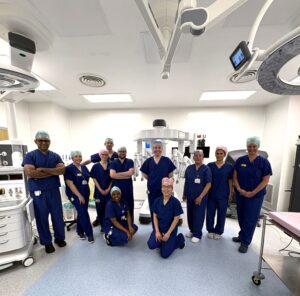 The Shrewsbury and Telford Hospital NHS Trust (SaTH) has expanded its use of robotic assisted surgery (RAS) with a new robot system based in the Elective Surgery Hub at PRH, which surgeons began using in April.
At the end of June, five gallbladder operations were performed in a single day using robotic technology, the highest number ever completed in one day using the system.
The robotic surgery carried out by Mr Saurav Chakravartty, Consultant Upper GI and Bariatric Surgeon, ran alongside another High Intensity Theatre (HIT) list at PRH.
Eleven non-robotic operations were carried out by Mr Adam Farquharson, Clinical Director and Lead for Robotic Assisted Surgery at SaTH – the usual maximum on a standard list is nine.
HIT-list procedures are planned and can be carried out on the same day. They focus on one type of procedure at a time, allowing for streamlined preparation, and maximising the number of patients being treated in one day.
Discharging patients who are fit enough on the same day or within a few days helps them to gain their independence sooner, return to normal activities and reduces the risk of infections.
SaTH first introduced robotic assisted surgery in 2023 at the Royal Shrewsbury Hospital (RSH) and has since operated on nearly 1,000 patients using the technology.
It is a form of keyhole surgery which enables the surgeon to perform operations that are more precise than conventional methods, and therefore cause less impact for the patient.
One of the main benefits of robotic assisted surgery is that patients recover more quickly and often go home much earlier than with non robotic surgery.
The new robotic system in Telford also allows surgeons to perform a high volume of routine, low complexity operations. The impact from complex surgery, including for advanced cancers, is significantly reduced and patients are able to resume their normal day-to-day activities very quickly.
Ned Hobbs, Group Chief Operating Officer, said: “It is fantastic that we are now using robotic assisted surgery across both RSH and PRH, allowing us to offer state-of-the-art surgical care to a greater number of our patients.
“This is an exciting development that will expand our capacity to deliver innovative, high-quality services and takes us another step closer to transforming healthcare for everyone in our communities.
“As well as bringing many benefits to our patients, robotic assisted surgery helps us to attract new generations of talent including surgeons, anaesthetists, nurses, operating department practitioners and healthcare staff.
“It’s been great to see how our highly skilled surgical team has embraced the new technology over the past few years, and it is thanks to their drive and dedication that we have been able to introduce a second robot.”
Mr Farquharson said: “Our aim is to offer the majority of keyhole surgery on the robotic systems over the next few years and we now have over 20 consultant surgeons delivering robotic assisted surgery across the Group.
“For patients this means that they will have access to modern surgical care for cancer and benign (non-cancerous) conditions, with a much-improved experience around the time of surgery as well as a quicker recovery.
“The robotic system at Telford is primarily focused on the treatment of women’s health conditions and routine low complexity abdominal surgery, such as hernia and gallbladder operations.”
Susan Lloyd was the first patient to have robotic assisted surgery at PRH in April.
Susan said: “My surgery went really smoothly and I was so impressed with how straightforward everything was. The team explained everything really well and took great care of me before, during and after the surgery.
“I was able to go home the same day as my operation and I am recovering well, with minimal pain, and feeling better every day.”
Caption: The Surgical Team ahead of the first robotic-assisted surgery at PRH