
24 November 2026
An Artificial Intelligence (AI) tool is helping local cancer patients receive radiotherapy treatment more quickly and accurately at The Shrewsbury and Telford Hospital NHS Trust (SaTH).
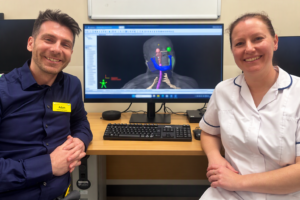 SaTH, which runs the Royal Shrewsbury Hospital and Princess Royal Hospital in Telford, is using an AI-powered system called Limbus to support the planning of radiotherapy treatments. The technology is helping to reduce waiting times for patients while saving significant clinical time.
Limbus is used to accurately identify healthy organs on planning CT scans that need to be protected during treatment planning.
This vital process, known as contouring, has traditionally required clinical staff to manually outline tumours and surrounding areas, which is a complex and time-consuming task.
With the support of AI, the contouring process saves around 10 hours per week compared to manual methods alone. This allows treatment plans to be prepared more quickly, helping patients to start their radiotherapy sooner.
The technology brings a range of benefits, including improved consistency, more efficient treatment planning and more time for staff to focus on other aspects of patient care.
It is currently being used at SaTH for all treatment sites to contour healthy organs and selected areas requiring treatment, with the potential to expand its use to a wider range of treatment targets in the future.
Dr John Jones, Group Chief Medical Officer, said: “This cutting-edge technology is making a real difference for both our patients and our staff. It has reduced the time needed for contouring whilst also improving the accuracy and consistency of treatment planning.
“By helping to prepare treatment plans more quickly, it is reducing the time patients wait between being referred for radiotherapy and starting potentially life-saving treatment, without compromising quality or safety.
“By combining the expertise of our clinical teams with the power of AI, we can continue to improve patient safety, outcomes and experiences whilst making the best use of our resources.
“Technology such as this will play an important role in the future of healthcare, but the human element of care remains essential. AI is supporting our clinicians rather than replacing them, allowing more time to be spent on delivering personalised care.
“We are extremely grateful to Lingen Davies, League of Friends and Shrewsbury and Telford Hospital Charity for their generous support, which has helped make this investment possible.”
Dr Rick Sims, Head of Radiotherapy Physics, said: “Contouring has always been a very time-consuming process, sometimes taking up to four hours for particularly complex cases. We are now seeing significant improvements in both efficiency and consistency.
“Extensive testing has been carried out to ensure this technology is safe and effective for use in the day-to-day care of radiotherapy patients across the NHS.
“The technology does much of the work in the background, meaning that when our clinical teams begin treatment planning, a lot of the heavy lifting is done. The clinical team remains fully in control, carefully reviewing and adjusting the contours where required.
“This is helping us see more patients, complete treatment plans more quickly and reduce overall turnaround times.
“We are also seeing considerable efficiency gains, including savings of around 10 hours within the radiotherapy physics team each week. That time can be refocused on supporting patients and developing the service.
“I am incredibly proud of how the team has embraced this innovation, and we look forward to exploring further opportunities to use AI and other digital tools to enhance patient care.”
Photo caption: Adam Williams and Claire Puzey from SaTH’s Radiotherapy Team with the Limbus AI tool